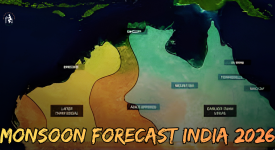
North India Monsoon 2026 is shaping up to be one of the most closely watched monsoon seasons in recent years, and not for good reasons.
Skymet has flagged a 60% chance of below-normal rainfall. El Niño is quietly developing. And IMD’s official forecast won’t drop until April 2026.
So right now, we’re watching, waiting, and reading early signals very carefully.
Read More: Tech Layoffs 2026: Companies, Numbers & What’s Next
What Are Forecasters Actually Saying About the North India Monsoon 2026?
Honestly, I want to start by saying something that most weather articles won’t tell you – nobody really knows yet. And that’s not me being lazy. That’s just how monsoon forecasting works before April.
There’s something called the spring barrier in climate science. Basically, global ocean temperatures are too unstable before March-April for any model to give you a reliable monsoon prediction. So anyone telling you with full confidence what June-September 2026 will look like in North India is probably guessing more than they’re admitting.
That said, early signals do matter and the ones we’re seeing right now are the kind that make you sit up a little.
What made me take this more seriously was a quote from the IMD Director General. He said – and I’m paraphrasing here – that it’s not even a full El Niño that worries him most. It’s an evolving El Niño. Because one that’s still building strength right in the middle of July and August? That’s when the monsoon is at its most critical in North India. That timing is the problem.
El Niño – Why It Matters for North India Monsoon 2026 Predictions
Okay bear with me for a second here because I know El Niño sounds like a chapter from class 10 geography. But this one actually connects directly to what happens in your fields and your groundwater levels.
When the IOD goes positive, it drives additional moisture toward India and can offset some of El Niño’s suppressive effect. In 2018, we actually dodged a bad year, partly because of a positive IOD.
Right now? IOD is neutral and forecasts suggest it’ll stay neutral for a while.
When Does the North India Monsoon 2026 Usually Reach Punjab & Haryana?
This trips people up a lot. It moves – slowly, from south to north, over about five to six weeks.
Kerala gets its first, usually around June 1. Then it pushes through Madhya Pradesh, Maharashtra, and moves up toward Rajasthan and Delhi around late June or early July. Punjab and Haryana are typically among the last to receive the monsoon, with it reaching them sometime between July 1 and July 8 in most years.
North India Monsoon 2026: Punjab Rainfall Forecast – The Realistic Picture
Punjab is always an interesting case because it’s sort of at the edge of where the monsoon loses energy.
If El Niño evolves the way Skymet is expecting, that southwestern belt of Punjab is the one I’d be most concerned about. It’s already borderline in a normal year.
The one thing Punjab has going for it and this is genuinely important, is its canal irrigation system. Unlike purely rain-dependent states, Punjab farmers can fall back on canal water for paddy to some extent.
IMD’s proper regional forecast won’t come until late May. Until then, watch the April broad forecast first, and then the May update for specifics.
North India Monsoon 2026 – Haryana’s Two Very Different Halves
If there’s one state where you really can’t talk about the rainfall forecast as if it’s one thing, it’s Haryana.
Now drive four hours west to Sirsa or Hisar and it’s practically a different climate. Western Haryana is semi-arid. 300 mm in a good year. Sometimes less. These areas depend on canal irrigation more than rain for farming.
In a below-normal monsoon – which again, is the more likely scenario based on current signals – it’s the western districts that’ll take the hit hardest. Cotton and bajra, which are grown there traditionally, handle drought better. But the worrying trend in recent years is that paddy has been expanding southward and westward in Haryana, into areas where it really doesn’t belong ecologically. Paddy in water-scarce Haryana during a weak monsoon year is not a great combination.
Haryana’s lifeline for water is the Bhakra-Nangal system, fed by Himalayan rivers. If Himachal Pradesh gets poor monsoon rains too, reservoir storage will go into late 2026 and the rabi season could get tight.
North India Monsoon 2026 in Uttar Pradesh – East and West Are Not the Same Story
UP often gets treated as one big block in weather discussions and that always bothers me a bit because it’s one of India’s most geographically varied states weather-wise.
Even in a below-normal monsoon, eastern UP usually manages reasonably well because the Bay of Bengal branch of the monsoon is historically more resilient during El Niño years than the Arabian Sea branch.
Western UP is where I’d worry more. They depend much more on that Arabian Sea moisture push that El Niño tends to weaken.
The timing issue that IMD raised is important for UP specifically. El Niño is expected to emerge or strengthen in July, August, and September. In UP, August is the peak monsoon. It’s when crops are at the most critical growth stages – paddy is flowering, grain is filling. A bad August in UP hits food production hard. We saw this in 2014. Farmers in eastern UP remember that year.
North India Monsoon 2026: A Few Practical Things Worth Doing Before June
I want to be clear – I’m not saying the India will definitely be bad. 60% is not 100%. And weather has surprised everyone before, including seasoned forecasters.
But if you’re someone who farms, or works in water management, or just needs to plan around North India Monsoon 2026 rainfall – here’s how I’d think about the next few months.
The IMD April forecast is your first real data point for the North India Monsoon 2026. Watch for it around the second or third week of April. It’ll give you a number – like 96% of LPA or 104% of LPA – which tells you whether they’re calling it below normal, normal, or above normal at a national level.
Then wait for the May update. That one gets more granular and includes regional breakdowns for Northwest India. That’s when Punjab and Haryana will get their own North India Monsoon 2026 picture.
Keep one eye on IOD news. If the IOD quietly shifts to positive territory by May or June, the North India Monsoon 2026 situation improves.
Read More: India vs Australia 2026: Live Updates & Match Analysis
Frequently Asked Questions: North India Monsoon 2026
North India Monsoon 2026: Will Rainfall Be Below Normal?
Early indications of Skymet gave an estimated 60 percent chance of below normal rainfall in India in 2026, including North India. The official IMD Long Range Forecast is, however, published in April, and regional information at the end of May. These initial figures are subject to and do change – nothing is determined yet.
When Is IMD Issuing the Official North India Monsoon 2026 Forecast?
IMD publishes its long-range forecast in mid-April. A second-stage breakdown forecasts are provided in late May. They both rely on global climatic models together with the Monsoon Mission Climate Forecast System of IMD.
What Crops and Regions Will Be Most at Risk if the North India Monsoon 2026 Is Weak?
The most vulnerable is Paddy – it is water-consuming and controls kharif acreage in Punjab and Haryana. The primary crops that are exposed to a below-normal monsoon in UP are paddy, sugarcane, and maize. The cotton in western Haryana is able to manage drought, but requires rainfall in the month of August when the bolls are developing.