


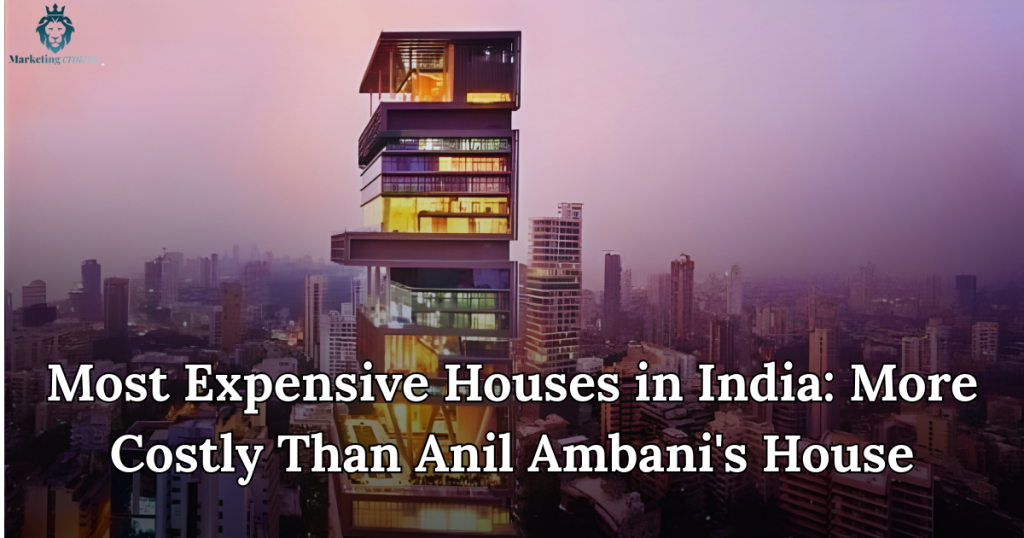
What comes to your mind when you think about the most expensive houses in India?
While many assume Anil Ambani’s Abode tops the list of most expensive houses in India, it’s surprisingly not even in the top three. His ₹5,000 crore residence in Pali Hill, Mumbai, is just the beginning of India’s ultra-luxury real estate story.
Read More: India’s First Air Taxi Factory – When I Heard About Flying Taxis Coming to Our Country
So, which are the most expensive houses in India?
Table of Contents
- Antilia
- JK House
- Abode
- Gulita
- Lincoln House
- Renuka Talwar Bungalow
- Adani Lutyens’ Bungalow
- Premji’s Whitefield Farmhouse
- Malabar Hills Triplex
Let us explore the most expensive houses in India that surpass even Anil Ambani’s luxurious residence:
1. Antilia – India’s Most Expensive House
Leading the list of the most expensive houses in India is Antilia – not just the country’s costliest residence but also one of the world’s most expensive homes!
Antilia is owned by Mukesh Ambani, the chairman of Reliance Industries. Situated on Mumbai’s Altamount Road, one of the city’s most expensive thoroughfares, this 568-foot skyscraper features 27 floors.
Designed by renowned Chicago-based architects, this architectural marvel is engineered to withstand earthquakes of up to 8 magnitudes on the Richter scale.
It houses the following amenities:
- Three helipads
- An 80-seat movie theatre
- An ice cream parlor
- A salon and spa
- A gym
- Multi-storey car parking
- A swimming pool
- Nine high-speed elevators
The interiors are exquisitely crafted using marble, crystals, and mother-of-pearl, with no two floors sharing the same design or material. A dedicated staff of approximately 600 individuals meticulously maintains this residence.
So, how costly is it?
Its estimated cost ranges from ₹6,000 crores to ₹12,000 crores.
2. JK House – Among the Most Expensive Houses in India
The second-tallest private residence in India, JK House, belongs to Gautam Singhania, the chairman of the Raymond Group. This property ranks among the most expensive houses in India and stands on the same prestigious Altamount Road as Antilia.
This 30-storey property features thoughtfully designed upper floors divided into separate residential units, ensuring privacy for each family member while offering soothing views from spacious gardens and terraces.
JK House houses the following amenities:
- Two swimming pools
- Five floors of dedicated parking
- A helipad (designed specifically for Singhania’s helicopters)
- A spa
- A gym
- Various other recreational facilities
Located in South Mumbai, JK House benefits from an excellent and desirable location.
So, how costly is it?
Valued at approximately ₹6,000 crores, this property embodies modern residential luxury.
3. Abode – One of the Most Expensive Houses in India
Anil Ambani’s residence, known as Abode, is a prominent entry among the most expensive houses in India.
Spanning a vast area of 16,000 square feet and standing 70 meters high, this 17-storey property includes its own helipad. Situated in Pali Hill, Mumbai, Abode previously served as home to Mukesh Ambani and his family before their relocation to Antilia.
The grand entrance features beautifully designed glass windows, allowing natural light to illuminate the elegant white interiors. The property is equipped with:
- A gym
- A spa
- A swimming pool
- Various amenities typical of a seven-star hotel
So, how costly is it?
With a valuation estimated at around ₹5,000 crores, Anil Ambani’s ‘Abode’ certainly warrants its place among the most expensive homes in the country.
4. Gulita
Gulita, a swanky mansion located in Worli, Mumbai, is owned by Isha Ambani and Anand Piramal. It ranks among the most expensive houses in India and indeed in the entire world.
Gulita was a wedding gift to the couple from Anand Piramal’s parents, Ajay Piramal and Swati Piramal. The property was purchased in 2015 and subsequently renovated, receiving its occupancy certificate in 2018.
Built on five floors, the house was constructed by Eckersley O’Callaghan, a London-based engineering firm.
So, how costly is it?
Gulita costs somewhere around ₹818 crores.
5. Lincoln House
This magnificent property belongs to Cyrus Poonawalla, the billionaire Chairman of the Serum Institute.
The property originally served as the mansion of a Maharaja of Wankaner and was sold to the U.S. government in 1957 for use as a Consulate house. Poonawalla finalized the deal for the mansion in 2015, after it had been on the market for four years.
Lincoln House holds the distinction of being a Grade-III heritage property. While such properties can be redeveloped as per heritage site policies, the Poonawalla family intends to use the house for residential purposes. The property spans 2 acres, with a total built-up area of 50,000 square feet.
So, how costly is it?
Located in the upscale Breach Candy area of South Mumbai, Lincoln House is a mansion valued at ₹750 crores.
6. Renuka Talwar Bungalow
Renuka Talwar, daughter of DLF’s chairman K.P. Singh, owns one of the most expensive houses in India, located on Prithviraj Road in New Delhi.
This bungalow forms part of the exclusive Lutyens Bungalow Zone of New Delhi, known for its approximately 1,000 luxurious bungalows. Renuka Talwar’s home features the most luxurious amenities. Notably, her father also owns two bungalows within this prestigious zone.
So, how costly is it?
This beautiful bungalow was purchased in 2016 for ₹435 crores.
7. Adani Lutyens’ Bungalow
Gautam Adani owns a luxurious property in Lutyens’ New Delhi, acquired through a bankruptcy resolution deal.
This palatial residence features a total built-up area exceeding 25,000 square feet, comprising:
- Seven bedrooms
- A study room
- Six dining and living rooms
- Separate staff quarters
- A generous 7,000 square feet of open garden
So, how costly is it?
This Lutyens’ New Delhi property is valued at ₹400 crores.
8. Premji’s Whitefield Farmhouse
Next on the list is the ultra-luxurious farmhouse of Azim Premji, the founder and former chairman of Wipro, located in Whitefield, Bangalore.
This impressive farmhouse spans 6,000 square feet, with high ceilings and pitched roofs lending it a distinctive appearance. The property’s natural beauty is further enhanced by stone cladding surrounded by lush greenery.
Unlike the vertical towers and sea-facing mansions of Mumbai, this property represents a different philosophy of luxury living – embracing nature and open spaces.
So, how costly is it?
The estimated cost of this residence is ₹350 crores.
9. Malabar Hills Triplex
Niraj Bajaj, the Chairman of Bajaj Auto, owns an architectural marvel in South Mumbai’s Malabar Hills, one of the most expensive houses in India.
This sea-facing property is equipped with all luxury amenities. A particularly attractive feature of this property is its eight dedicated parking lots, reflecting the opulence of this triplex.
So, how costly is it?
This property was purchased in 2023 from Macrotech Developers for ₹252 crores.
Read More: Indian Stock Market Today: 8 Key Things You Need to Know Before Markets Open
Wrapping Up
When someone asks what costs more than Anil Ambani’s house, the answer is quite a lot. His ₹5,000 crore Abode doesn’t even make the top three.
These properties showcase a level of wealth and architectural ambition that most of us can only imagine. From vertical towers with multiple helipads to heritage mansions and sprawling farmhouses, India’s most expensive homes reflect the diverse tastes and lifestyles of the ultra-wealthy.
These residences tell us about real estate trends in India, about where money flows, and about what’s technically possible when budget isn’t a concern. Whether it’s three helipads, 600 staff members, or an entire ice cream parlor inside a home, these properties push the boundaries of residential luxury.
The diversity is remarkable – some billionaires want vertical towers with helipads, while others prefer farmhouses with trees. Some choose heritage properties with history, while others commission cutting-edge modern architecture.
What they all have in common is this: they represent dreams realized without financial constraints, showcasing what architects and engineers can achieve when clients say, ‘do whatever you want.’